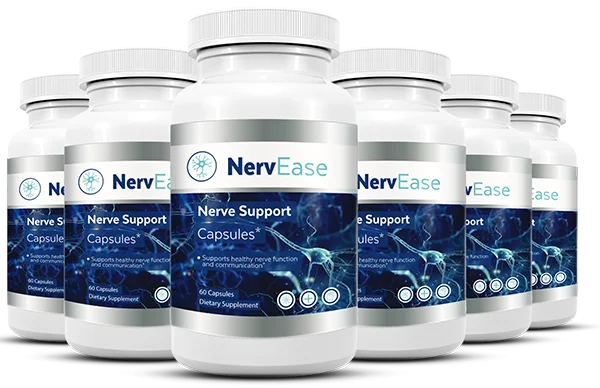
Every ingredient with its mechanism, dosage, and role in nerve health.
Last Updated: April 1, 2026 · Medically Reviewed by Dr. Marcus Chen, ND
I am going to walk through every ingredient on the NervEase label. Not the marketing version — the actual what-does-this-do version. Five botanicals, each with a specific job related to how nerve pain works. No filler herbs thrown in to make the label look impressive. No proprietary fairy dust. Just five plants that traditional medicine figured out centuries ago and modern research is catching up to.
Passionflower is the largest dose in the formula and that is deliberate. This plant has been used in Native American and European herbal traditions for hundreds of years, mostly for calming the nervous system. The mechanism that modern science has identified involves GABA — gamma-aminobutyric acid — which is basically your brain’s brake pedal (PMID: 32099999). When GABA levels go up, nerve firing slows down. That overactive buzzing, tingling, and pain signaling that keeps your nervous system on high alert starts to quiet. Passionflower nudges GABA levels higher without the drowsiness risks of pharmaceutical sedatives, though some people do notice a mild calming effect especially if they take it in the evening.
For nerve pain specifically, the GABA connection matters because a lot of chronic nerve discomfort is not purely about physical damage. Your nervous system gets stuck in a loop where it amplifies pain signals beyond what the actual tissue damage warrants. Passionflower helps interrupt that loop. It is also why gabapentin (a prescription nerve drug) works on a similar principle — it modifies GABA activity. Passionflower is a gentler, non-prescription version of that same pathway.
Marshmallow Root has nothing to do with the candy. The plant produces a thick, gel-like substance called mucilage that coats and soothes irritated tissue. If you have ever had a sore throat lozenge with marshmallow root, you know the feeling — it creates a protective layer over inflamed surfaces. In the context of nerve health, that soothing action targets the inflamed tissue surrounding nerve pathways. When swelling around the sciatic nerve or peripheral nerve branches presses on the nerve itself, you get shooting pain, tingling, and numbness. Marshmallow Root helps calm that tissue-level inflammation.
The anti-inflammatory angle is underrated in nerve supplements. Most formulas focus entirely on nerve nutrition (B-vitamins) or pain blocking, but they ignore the physical swelling that is literally squeezing the nerve. If you have sciatica, the nerve root exiting your spine is compressed by inflamed tissue in most cases. Reducing that inflammation is often the fastest path to relief, which is why users frequently report that NervEase starts helping within the first two weeks — before the other mechanisms have fully kicked in.
This one is the most interesting ingredient in the formula from a pharmacological standpoint. Corydalis has been used in Traditional Chinese Medicine for centuries to manage pain. The active compound researchers have identified is called dehydrocorybulbine — DHCB for short — and it works on dopamine receptors in a way that changes how your brain perceives chronic pain (PMID: 31031049). That is a fundamentally different mechanism than NSAIDs (which reduce inflammation) or opioids (which bind to opioid receptors and carry addiction risk). DHCB modulates pain through a pathway that does not create dependency, which is a big deal for people dealing with ongoing nerve discomfort.
The practical translation: Corydalis does not numb you. It does not knock you out. It adjusts the volume knob on pain signals that your brain has been stuck amplifying. People with chronic sciatica or peripheral neuropathy often describe their pain as disproportionate to what is actually happening physically. That amplification is partly a brain-level phenomenon, and Corydalis addresses it at that level.
Prickly Pear is a cactus, and the 20:1 extract concentration means you are getting a potent dose of its active compounds, particularly betalains and polyphenols. These are antioxidants, and before your eyes glaze over at another antioxidant claim — here is why this one matters specifically for nerves. Nerve cells are unusually vulnerable to oxidative stress because they have high metabolic rates and long cellular structures (some nerve fibers extend over a meter in length). When free radicals damage these cells, the myelin sheath — the protective coating around nerve fibers that allows signals to travel efficiently — starts breaking down. That breakdown is literally what causes the tingling, numbness, and burning sensations in peripheral neuropathy.
Prickly Pear delivers targeted antioxidant protection to these vulnerable cells. At 50mg of 20:1 extract, the concentration is meaningful rather than token. This is the long-game ingredient in the formula — it does not provide immediate pain relief, but it supports the structural integrity of your nerve fibers over weeks and months of consistent use.
California Poppy is not related to opium poppies and does not contain opioid compounds. It interacts with GABA receptors (similar to Passionflower but through different binding sites) to promote muscle relaxation and mild pain relief. The muscle relaxation piece is critical for sciatic nerve pain specifically, because tight piriformis muscles, hip flexors, and spinal muscles are often the physical structures compressing the nerve. When those muscles relax, the mechanical pressure on the nerve decreases, and the shooting pain that travels down the leg starts to ease. California Poppy also has mild sedative properties, which is why some NervEase users report sleeping better — a welcome side effect when nerve pain has been keeping you up at night.
All five ingredients are plant-based with long traditional use histories. The most commonly reported side effect is mild drowsiness, which makes sense given that Passionflower and California Poppy both work on GABA pathways. If you notice this, taking NervEase with your evening meal instead of morning may help. Some individuals experience mild digestive adjustment in the first few days. People with plant allergies should review the full ingredient list. If you take prescription medications — especially gabapentin, pregabalin, blood pressure medications, or anything affecting liver metabolism — talk to your doctor before starting NervEase. Not recommended during pregnancy or nursing. For adults 18+ only. 14,000+ users report no significant adverse effects.
The capsule shell is Hydroxypropyl Methylcellulose (vegetable-based, suitable for vegetarians). Other inactive ingredients include Microcrystalline Cellulose (fiber filler for capsule consistency) and Magnesium Stearate (flow agent used in virtually all capsule supplements). No dairy. No soy. No gluten. No artificial colors or preservatives. Non-GMO. Non-addictive. Made in an FDA-registered, GMP-certified facility in the USA. The 60-day guarantee gives you two full months to see whether these five botanicals make a difference for your nerve pain.
Five botanicals. Five specific doses listed on the label. Four mechanisms of nerve support addressed. No B-vitamins padding the ingredient count. No generic "proprietary blend" hiding what you are actually getting. Just five plants that hundreds of years of traditional medicine identified as helpful for nerve discomfort, and that modern research is beginning to validate through identified mechanisms like DHCB dopamine modulation and GABA receptor interaction. That focused, honest approach is rare in the nerve supplement market and it is why 14,000+ people rated NervEase 4.9 stars. The 60-day guarantee lets your nerves be the judge.
Something worth mentioning that most supplement pages skip: the doses matter as much as the ingredients. Passionflower at 145mg is a clinically relevant amount. Corydalis at 100mg provides meaningful DHCB content. Marshmallow Root at 110mg delivers enough mucilaginous compounds to soothe tissue. Prickly Pear as a 20:1 extract at 50mg concentrates the active antioxidants. California Poppy at 45mg provides GABA interaction without excessive sedation. These are not token sprinkle amounts. They are doses selected to produce the effects their mechanisms predict. That distinction separates NervEase from supplements that list 15 ingredients at 5mg each.
Walk into any vitamin shop and the nerve supplements lining the shelves have ingredient lists that go on forever. Fifteen, twenty ingredients crammed into one capsule. Sounds impressive on the label but the math does not work. A capsule holds roughly 500–700mg of material. Split that across 20 ingredients and each one gets 25–35mg — a token amount too small to do anything. NervEase takes the opposite approach: five ingredients at doses that actually matter. Passionflower at 145mg. Marshmallow Root at 110mg. Corydalis at 100mg. These are amounts chosen because research and traditional use suggest they produce real effects at those levels, not sprinkle amounts meant to pad a label.
There is another reason the five-ingredient approach works better for nerve support. Nerve pain involves multiple mechanisms happening at once — inflammation, signal amplification, oxidative damage, muscle tension. You need ingredients that cover each mechanism but you do not need five different ingredients per mechanism. One strong anti-inflammatory at proper dose beats three weak ones at trace amounts. One GABA-modulating botanical at clinical dose beats a blend of five calming herbs at homeopathic doses. Focused formulas with real doses outperform scattered formulas with token doses every time. That is basic pharmacology, and it is why 14,000+ people rated NervEase 4.9 stars after finding the big-label alternatives gave them nothing.
Something worth mentioning: the doses matter as much as the ingredients. Passionflower at 145mg is clinically relevant. Corydalis at 100mg provides meaningful DHCB content. Marshmallow Root at 110mg delivers enough mucilaginous compounds to soothe tissue. Prickly Pear as a 20:1 extract at 50mg concentrates the active antioxidants. California Poppy at 45mg provides GABA interaction without excessive sedation. These are not token amounts. They are doses selected to produce the effects their mechanisms predict. That distinction separates NervEase from supplements listing 15 ingredients at 5mg each. Five focused botanicals. Four nerve support mechanisms. Doses that actually do something. The 60-day guarantee lets your nerves confirm it.
The five-ingredient philosophy is about cutting through noise. Nerve pain has four drivers: inflammation, signal amplification, oxidative damage, muscle tension. You need one strong ingredient per mechanism, not five weak ones. Passionflower handles GABA. Marshmallow Root handles inflammation. Corydalis handles pain signals. Prickly Pear handles oxidation. California Poppy handles muscles. Five problems. Five solutions. Nothing wasted.
14,000+ users tried those kitchen-sink formulas first. They switched to NervEase because five right ingredients at real doses outperformed twenty wrong ones at trace amounts. 60-day guarantee. Two capsules daily. Five botanicals covering four mechanisms. Your nerves will confirm it.
Five botanicals. Five specific doses. Four mechanisms of nerve support. No filler herbs. No trace amounts. No proprietary blend hiding what you are actually getting. Every ingredient on the NervEase label is searchable on PubMed. Every dose is listed in plain numbers. That transparency is not standard in the supplement industry and it matters when you are trusting a product with your nerve health. The 60-day guarantee backs the transparency with financial accountability. If the five ingredients at their listed doses do not improve your nerve comfort, your money comes back.
Two capsules. Five botanicals. Four nerve support mechanisms. Your evaluation starts tonight.
Five botanicals. Four mechanisms. Doses that matter. Your evaluation starts tonight with two capsules and a 60-day guarantee.